In Section 2.3 we studied arguments with logical statements. In this chapter we’ve looked at statements with quantifiers. Now we want to combine the two ideas.
Recall, an argument is valid if whenever the premises are true, the conclusion must be true. An argument is invalid if it is possible for the premises to be true and the conclusion false.
Although Example 3.4.1 and Example 3.4.2 are valid arguments, we will have trouble using a truth-table to determine validity. In this section we will develop other tools for analyzing quantified arguments. These examples are extensions of modus ponens and modus tollens from Some Common Forms for Valid Arguments.
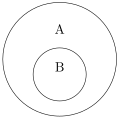
To determine validity of quantified arguments we need to ask if it is possible for the premises to be true while the conclusion is false. If it is possible, then the argument is invalid. If it is not possible, then the argument is valid. We will use Venn diagrams to help us determine validity. A Venn diagram is just a picture where we use circles to represent sets of objects and points to represent specific elements. We draw the circles to represent how our sets are related to each other.
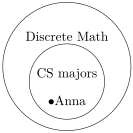
One circle inside another circle, with a point in the inside circle. The outer circle is labeled “Discrete Math”, the inner circle is labeled “CS majors”, the point is labeled “Anna”.
The picture represents the two premises of the argument. In the Venn diagram we have a circle representing students taking Discrete Math (“Discrete Math”) and a circle representing computer science majors (“CS majors”). The CS major circle is completely inside the Discrete Math circle since the first statement in the argument is that all computer science majors take Discrete Math. This means the set of computer science majors is a subset of the set of students taking Discrete Math. The second statement in the argument is that Anna is a computer science major. This means Anna is an element (represented by a point) of the set of CS majors.
Now, if we look at the diagram determined by the two premises, we see that Anna must also be an element of the set of students taking Discrete Math. Thus, it is not possible to have true premises and a false conclusion.
Sometimes there is a choice about where to place a certain element of a set. For example, if I know \(x\) is not in set A, then \(x\) might be in set B or it might not be in B. We can use these choices to see if we can make the premises true and the conclusion false.
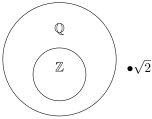
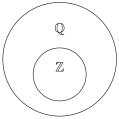
The two premises are represented with the following diagram. Recall, \(\mathbb{Q}\) is the set of rational numbers and \(\mathbb{Z}\) is the set of integers.
One circle inside another circle, with a point outside both circles. The outer circle is labeled “\(\mathbb Q\)”, the inner circle is labeled “\(\mathbb Z\)”, the point is labeled “\(\sqrt{2}\)”.
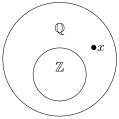
But we need to be careful about where we place \(x\text{.}\) The second premise just says it needs to be inside the rational circle. Is it possible to place it in the rational circle so that the conclusion is false? Yes, we can place \(x\) inside the rational circle, but not in the integer circle. So the following diagram shows how it is possible to have true premises and a false conclusion.
One circle inside another circle, with a point inside the outer circle, but outside the inner circle. The outer circle is labeled “\(\mathbb Q\)”, the inner circle is labeled “\(\mathbb Z\)”, the point is labeled “\(x\)”.
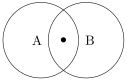
Two circles next to each other with some overlapping area. The left circle is labeled “\(A\)”, the right circle is labeled “\(B\)”. There is an unlabeled point in the center of the overlapping area.
Determine if the argument is valid or invalid. If it is valid, state whether it is an example of modus ponens or modus tollens. If it is invalid, state whether it exhibits converse error or inverse error.